
 English
 русский
 Español
 Indonesia
 Tiếng Việt
 Current Location:
-
Drum Handling Tools: Making Oil Drum Lifting, Moving and Positioning Easier | MKBK Hoist
-
Mobile Hydraulic Electric Crane with Automatic Telescopic Boom: Move, Lift and Position Heavy Loads with Less Effort
-
Manual Balanced Fork Crane 1–5 Ton: A Practical Lifting Solution for Tight Spaces
-
Mixed Loading Material Handling Equipment in One 40HQ Container: A Smarter Way to Reduce Shipping Costs
Online consulting
If you have any questions, please contact our online customer service staff immediately
Retractable Lifeline: Small Device, Big Responsibility
 Click:582
  Time:2026-08-26 17:03:51
A good fall protection device is not the one you notice every day — it is the one that works exactly when you need it most.
When people first see a Retractable Lifeline, it may look like a simple compact box with a cable or webbing inside.
But there is much more happening inside.
A spring controls the retraction.
A drum manages the lifeline.
A locking mechanism reacts to sudden movement.
An energy-absorbing system helps control the force during a fall.
And every component has a job.
At MKBK Hoist, we manufacture Retractable Lifelines in volume, covering 8 specifications from 5s to 40s, with customization available for different customer requirements and applications.
This article explains what a Retractable Lifeline actually does, how the mechanism works, what the different specifications mean, and what engineers consider when selecting the right model.
What Is a Retractable Lifeline?
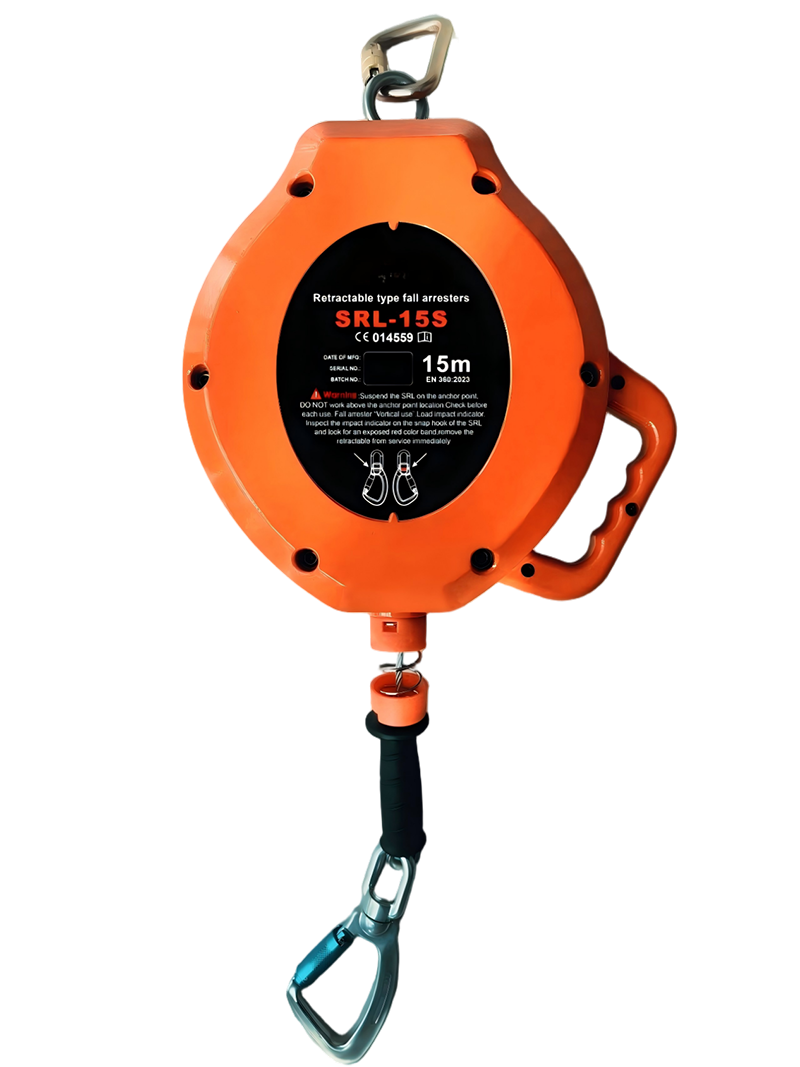
A Retractable Lifeline, also known as a Self-Retracting Lifeline (SRL) or self-retracting fall arrest device, is designed to provide workers with greater freedom of movement while maintaining controlled connection to an anchorage point.
Unlike a conventional fixed-length lanyard, the lifeline can automatically extend and retract as the worker moves.
Think about a car seat belt.
When you move slowly, the belt allows movement.
Pull it suddenly, and it locks.
A Retractable Lifeline uses a similar basic idea, but it is engineered for fall protection and much more demanding working conditions.
During normal movement, the internal drum allows the lifeline to pay out and retract under controlled tension.
If a sudden high-speed extension occurs, the locking mechanism is designed to engage and stop further payout.
That is the basic working principle of an SRL.
But from an engineering perspective, the real challenge is not simply making it lock.
The challenge is making it lock reliably, control the stopping process, and maintain consistent performance.
How Does a Retractable Lifeline Work?
Let's take the housing apart conceptually.
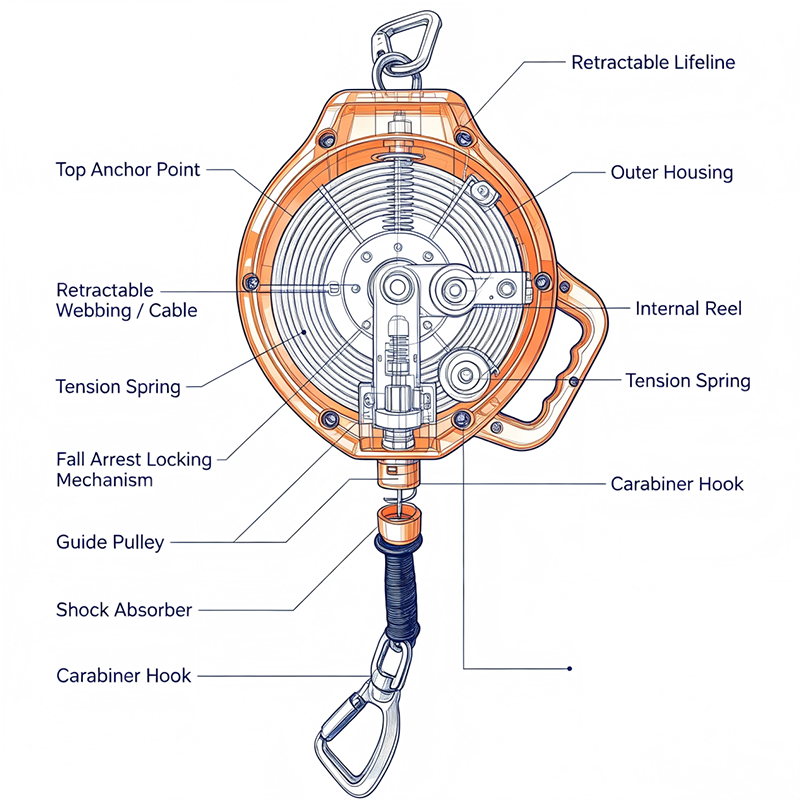
Inside a typical Retractable Lifeline, you will find several important components.
1. Lifeline
This can be a steel cable, webbing or another suitable line depending on the design.
The lifeline connects the worker to the device while allowing controlled movement.
2. Drum
The lifeline is wound around an internal drum.
As the worker moves away from the anchorage point, the line pays out.
As the worker moves closer, the drum rotates in the opposite direction and retracts the line.
3. Retraction Spring
The spring provides the force needed to automatically take up excess lifeline.
This helps prevent unnecessary slack during normal movement.
4. Locking Mechanism
This is one of the most important parts.
When the lifeline is pulled out at a sufficiently high speed, the internal mechanism detects the abnormal rotational movement and locks the drum.
Different designs use different mechanical principles, but speed- or acceleration-responsive locking is a common approach.
5. Energy Absorption System
Stopping a fall is not simply about stopping movement instantly.
The system also needs to manage the energy generated during the fall.
This is why energy absorption is an important part of fall arrest equipment.
From an engineering point of view, this is where product quality becomes especially important.
A locking mechanism that works in a laboratory test is one thing.
A mechanism that performs consistently after repeated extension, retraction, temperature changes, dust exposure and daily use is another.
Why Does the Lifeline Need to Retract Automatically?
This is a question customers sometimes ask.
Why not simply use a fixed-length lanyard?
Because workers move.
Imagine a worker inspecting a large industrial structure.
If the connection is too short, movement becomes restricted.
If the connection is too long, unnecessary slack can develop.
A Retractable Lifeline automatically adjusts the available line according to movement.
The worker can move around the work area while the line remains under controlled tension.
This is one of the main practical advantages of SRL systems.
In simple terms:
More movement freedom, less unnecessary slack.
That sounds like a small improvement.
In real working environments, it can make a big difference.
5s to 40s: What Do These Specifications Mean?
One detail is especially important when discussing MKBK Hoist Retractable Lifelines:
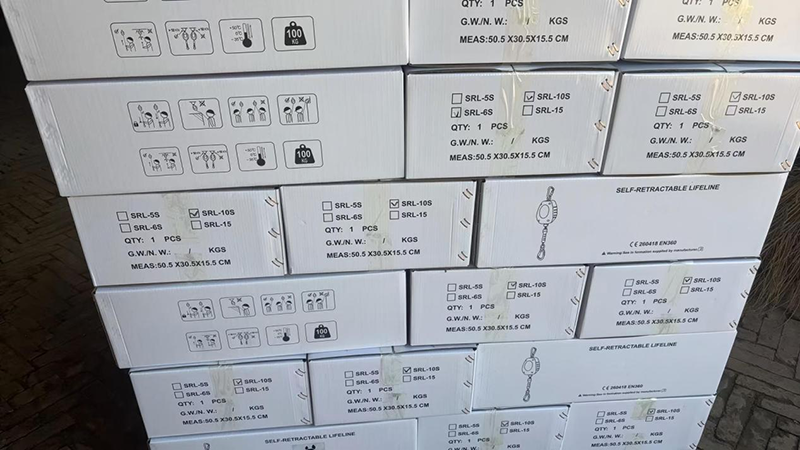
The specifications are 5s–40s.
Here, “s” means seconds, not meters.
This refers to the specific product/model classification used in our range, and should not be confused with lifeline length expressed in meters.
MKBK Hoist currently offers 8 specifications from 5s to 40s.
Why offer eight specifications instead of just one or two?
Because working environments are different.
A compact application may require one configuration.
A heavier-duty industrial application may require another.
Customers may also have different requirements for:
· Lifeline configuration
· Working conditions
· Installation method
· Working range
· Housing size
· Connector configuration
· Material
· Quantity
· Customer-specific specifications
From a manufacturing perspective, offering multiple specifications allows us to match the device more closely to the customer's actual application.
The Most Important Question Is Not “How Long?”
When purchasing a Retractable Lifeline, many buyers immediately ask:
“What is the length?”
That is understandable.
But our engineers normally ask several questions before recommending a model.
Where will it be used?
A factory maintenance application is different from a construction site.
How will it be installed?
The anchorage position and installation direction matter.
How much movement does the worker need?
A worker performing inspection may move differently from someone performing fixed-position maintenance.
What environment is involved?
Dust, moisture, temperature, corrosion and other conditions can affect equipment selection and service life.
What standards are required?
Different markets and projects may have different compliance requirements.
For example, EN 360 is a commonly referenced European standard for self-retracting fall arrest devices.
This is why buying a Retractable Lifeline should not be treated like buying an ordinary hardware accessory.
It is part of a complete fall protection system.
Retractable Lifeline vs. Traditional Fixed Lanyard
So, which one is better?
Neither is automatically better.
It depends on the job.
A fixed-length lanyard is straightforward and can be suitable for certain applications.
A Retractable Lifeline becomes attractive when the worker needs more freedom of movement while maintaining controlled line tension.
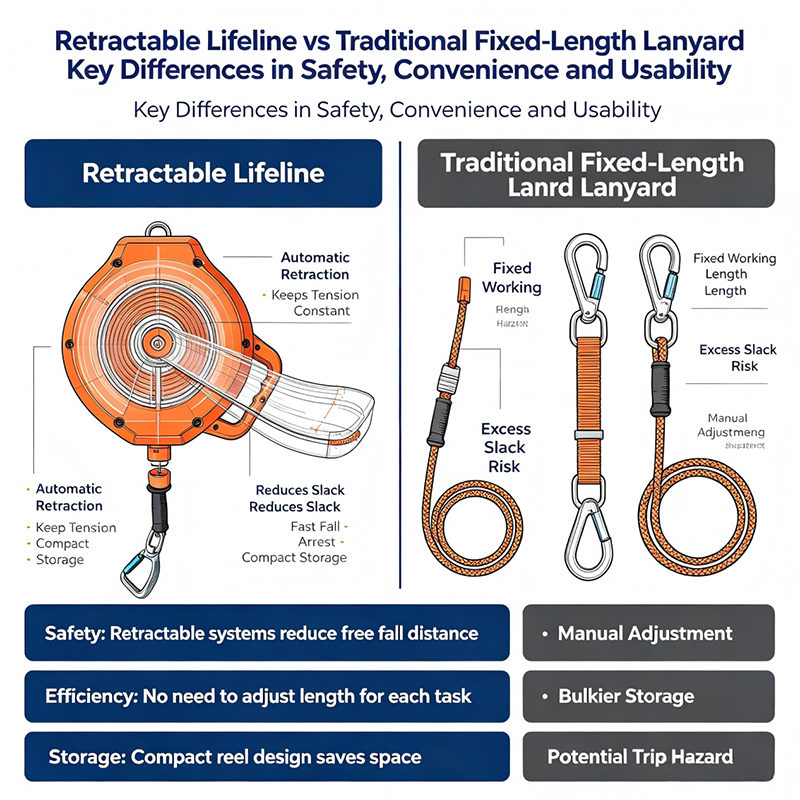
From the user's perspective, the difference is easy to understand:
Fixed lanyard:
The connection length is predetermined.
Retractable Lifeline:
The available line changes with the worker's movement.
This makes SRLs particularly useful in applications where workers need to move around while remaining connected.
What Happens During a Fall?
This is where the engineering really matters.
Under normal conditions, the lifeline can extend and retract smoothly.
But during a fall, the lifeline can be pulled from the drum much faster.
The internal mechanism detects this rapid payout and activates the locking system.
The drum is prevented from continuing to rotate freely, and the fall arrest system begins controlling the fall.
Depending on the product design, energy absorption components then help manage the forces generated during the arrest event.
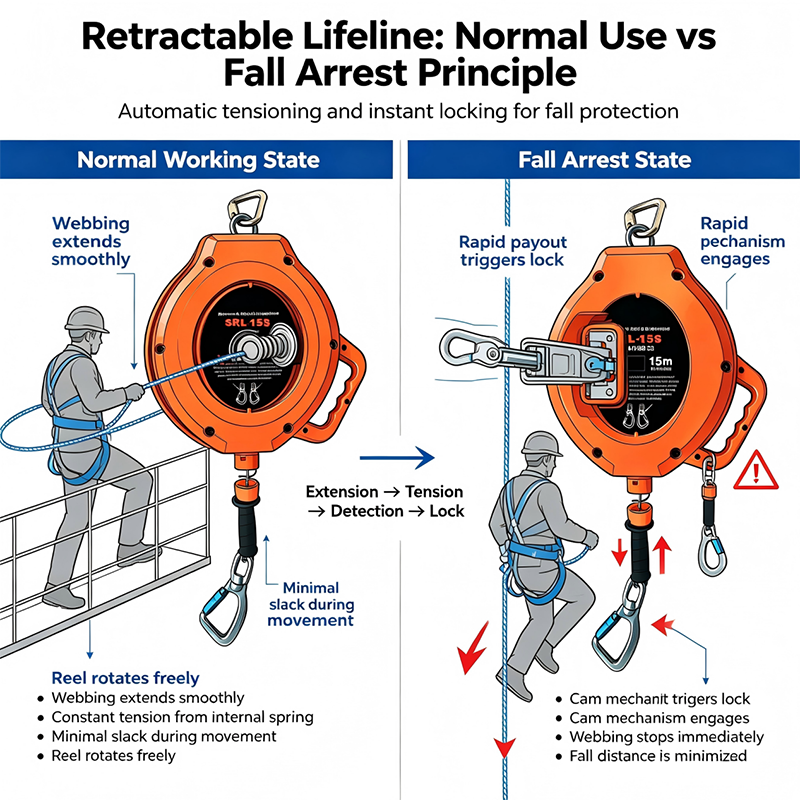
This is why the internal mechanism cannot be treated as an afterthought.
A tiny spring, pawl, drum component or bearing may look insignificant.
But when the device is required to perform during a fall event, every component suddenly becomes extremely important.
What Does an Engineer Look at During Production?
At MKBK Hoist, our engineers do not only look at the outside appearance.
They pay attention to the relationship between the components.
For example:
Retraction force
The lifeline needs to retract properly without making normal movement unnecessarily difficult.
Locking response
The mechanism needs to respond correctly to rapid payout.
Drum operation
The drum needs to rotate smoothly during normal use.
Housing
The housing protects the internal components and needs to suit the intended working environment.
Connector
The connection point needs to match the intended application and product configuration.
Energy absorption
The energy-absorbing design needs to work as part of the overall fall arrest system.
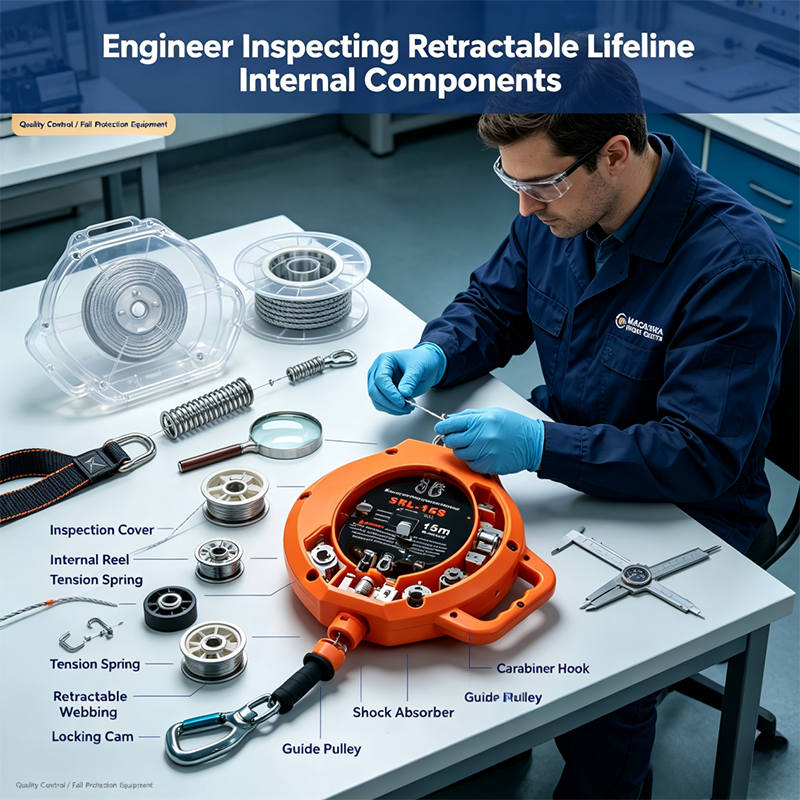
Good engineering is often invisible.
You may never notice the internal spring.
You may never see the locking pawl.
You may never think about the drum bearing.
But these are exactly the details that engineers spend time thinking about.
Where Are Retractable Lifelines Used?
Retractable Lifelines can be considered for many work-at-height applications.
Typical applications include:
· Construction
· Factory maintenance
· Steel structure installation
· Warehouse maintenance
· Industrial equipment inspection
· Roof work
· Tank maintenance
· Power and utility work
· Elevated platforms
· Infrastructure maintenance
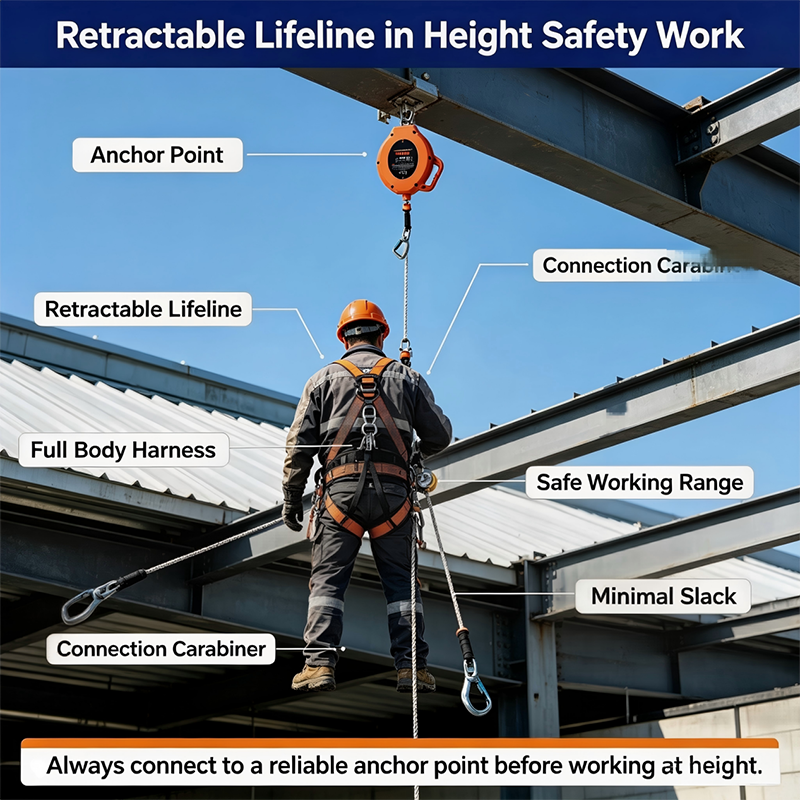
However, the device should always be selected and used according to the manufacturer's instructions, applicable standards and the specific fall protection system.
An SRL is not a replacement for proper anchorage planning.
It is one component of the system.
Why Customization Matters
Not every customer needs exactly the same product.
For distributors, this is especially important.
You may have a local market that prefers a specific connector.
Your customers may require a particular housing material.
A project may specify a certain lifeline configuration.
Or perhaps you need your own brand, packaging or product labeling.
MKBK Hoist supports customized production according to customer requirements.
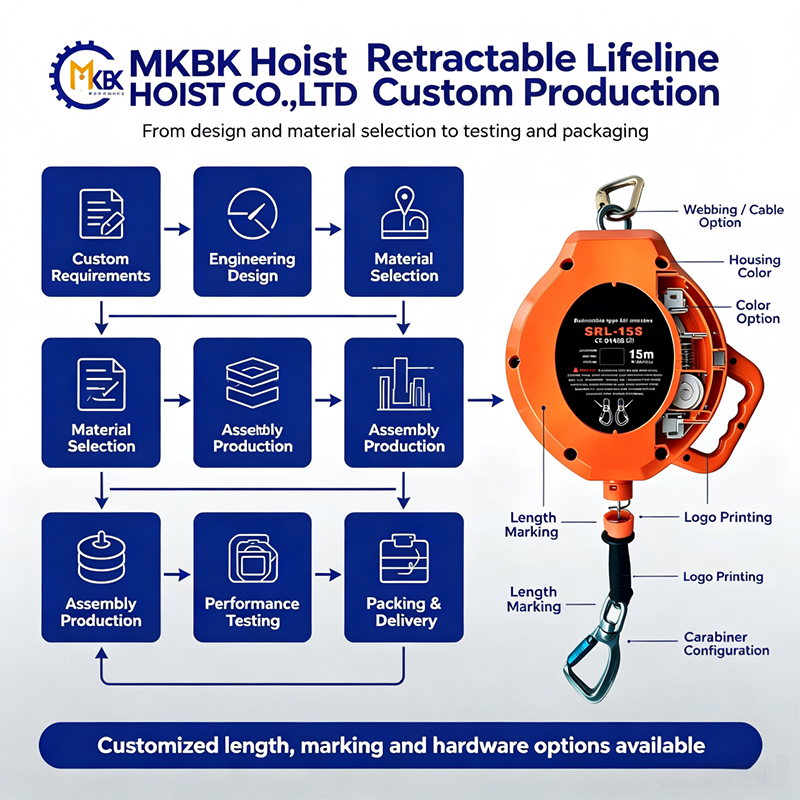
Customization can include, depending on the product and technical feasibility:
· Lifeline configuration
· Connector options
· Housing configuration
· Product labeling
· Packaging
· Color
· Branding
· Specification requirements
· Bulk production requirements
Our engineers review the technical requirements before production rather than simply changing one component and assuming everything else remains unchanged.
That is important because a fall protection device is a system.
Changing one part can affect another.
From Small Components to Mass Production
MKBK Hoist is a manufacturer with the ability to produce Retractable Lifelines in volume.
For distributors and importers, stable production capacity can be just as important as the product itself.
You may not need 20 pieces.
You may need hundreds or thousands.
In that situation, consistency becomes critical.
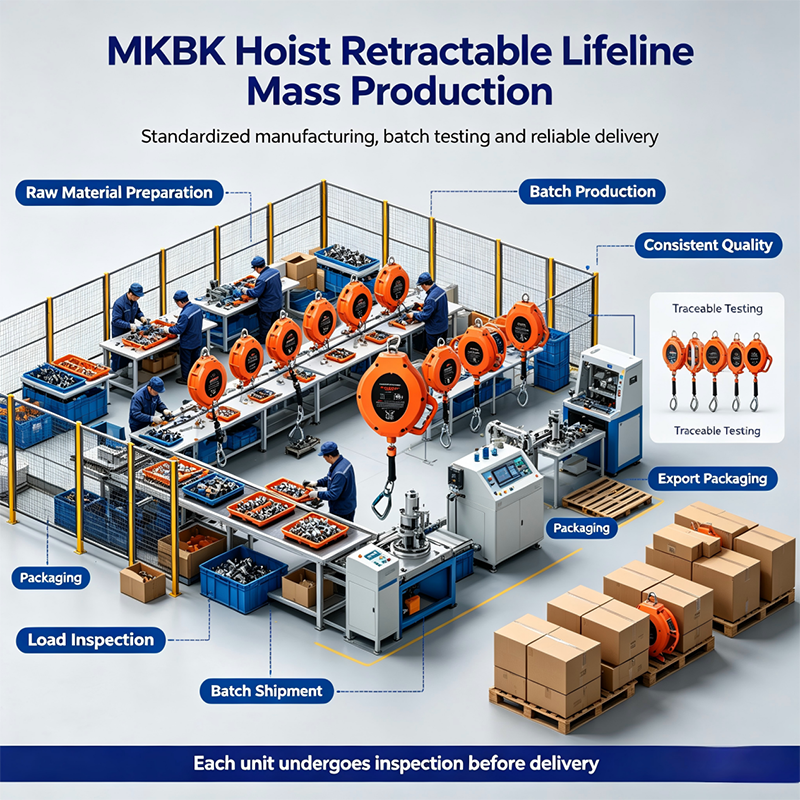
Our production process focuses on:
1. Raw material preparation
2. Component processing
3. Internal mechanism assembly
4. Housing assembly
5. Lifeline installation
6. Connector installation
7. Functional inspection
8. Product testing
9. Final quality inspection
10. Packing and shipment
The goal is simple:
Make the next batch as consistent as the previous one.
That is what mass production should achieve.
How Should Buyers Choose a Retractable Lifeline?
If you are sourcing SRLs for your company, don't ask only:
“What's your price?”
Start with these questions:
1. What application is it for?
Construction? Maintenance? Industrial inspection?
2. What specification do you need?
MKBK Hoist offers 8 specifications from 5s to 40s.
3. What type of lifeline is required?
Cable, webbing or another configuration?
4. What connector is required?
Different applications may require different connection configurations.
5. What standard or certification is required in your market?
This should be confirmed before placing an order.
6. What quantity do you need?
If you are a distributor, stable batch production matters.
7. Do you need customization?
Branding, packaging, connectors and other requirements can be discussed before production.
One More Thing: Never Ignore Inspection
Fall protection equipment is safety equipment.
Before use, users should follow the manufacturer's inspection and operating instructions.
The condition of the lifeline, housing, connector and other components should be checked.
If the equipment shows damage or has been involved in a fall arrest event, it should be handled according to the manufacturer's instructions and applicable requirements rather than simply put back into service.
Some SRL manufacturers also provide impact indicators to help identify whether a fall arrest event has occurred.
This is not the exciting part of the product.
But experienced safety professionals know that maintenance and inspection are just as important as the initial purchase.
Why Choose MKBK Hoist?
At MKBK Hoist, we believe a fall protection product should be understood from both sides:
The buyer wants reliable supply.
The engineer wants reliable performance.
The end user wants confidence when working at height.
That is why our focus is not only on producing one model.
We build a product range.
Our Retractable Lifeline series covers 8 specifications from 5s to 40s, supports bulk production and can be customized according to customer requirements.
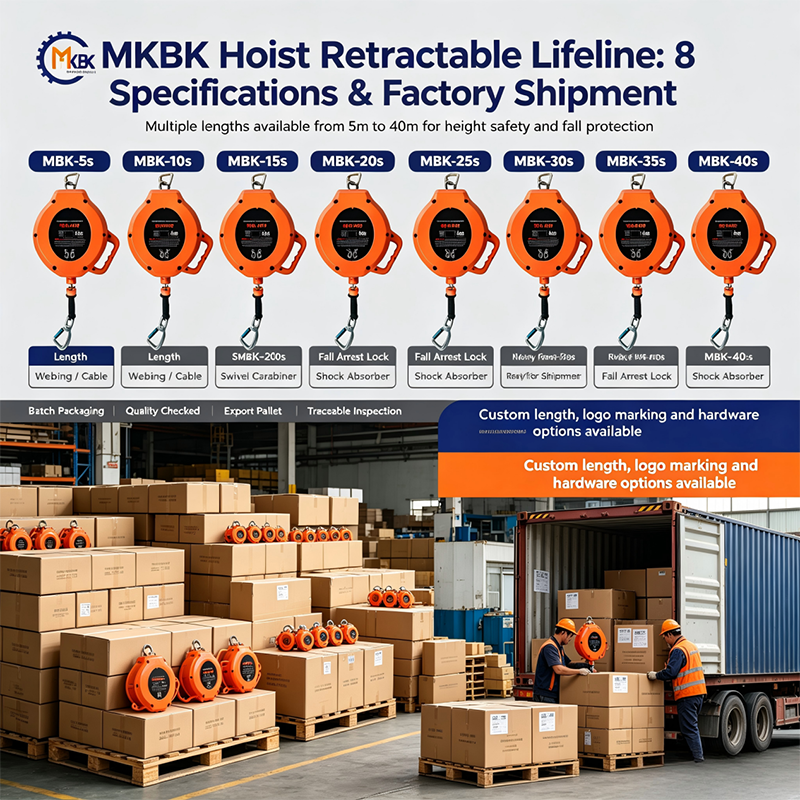
Whether you are a distributor looking to expand your fall protection product line, an importer sourcing from China, or an industrial customer looking for a customized solution, our team can discuss your requirements with you.
Send us your application, required specification, quantity and customization requirements.
Our engineers will help you evaluate the suitable configuration.
Because when it comes to fall protection, the smallest component can carry the biggest responsibility.
MKBK Hoist — Built for the moment when reliability matters most.
 Factory Address: Dongl ü industrial Area,Qingyuan District, Baoding City, Hebei Province, China
 Contact number:
 Emall:
  Website:





 Home
Home Whatsapp
 Email
Email