
 English
 русский
 Español
 Indonesia
 Tiếng Việt
 Current Location:
-
Drum Handling Tools: Making Oil Drum Lifting, Moving and Positioning Easier | MKBK Hoist
-
Mobile Hydraulic Electric Crane with Automatic Telescopic Boom: Move, Lift and Position Heavy Loads with Less Effort
-
Manual Balanced Fork Crane 1–5 Ton: A Practical Lifting Solution for Tight Spaces
-
Mixed Loading Material Handling Equipment in One 40HQ Container: A Smarter Way to Reduce Shipping Costs

Online consulting
If you have any questions, please contact our online customer service staff immediately
Double Layered Handcart: Why a Simple Two-Level Design Can Make Material Handling Much Easier
 Click:585
  Time:2026-08-31 14:40:18
In a busy warehouse, factory, workshop or distribution center, moving materials is rarely a one-time job.
Boxes need to be moved from storage to production.
Tools need to be taken to a maintenance area.
Parts need to travel between workstations.
Finished products need to be moved to packing or loading areas.
When this happens dozens or even hundreds of times every day, a small improvement in the handcart can make a surprisingly big difference.
This is where a Double Layered Handcart becomes useful.
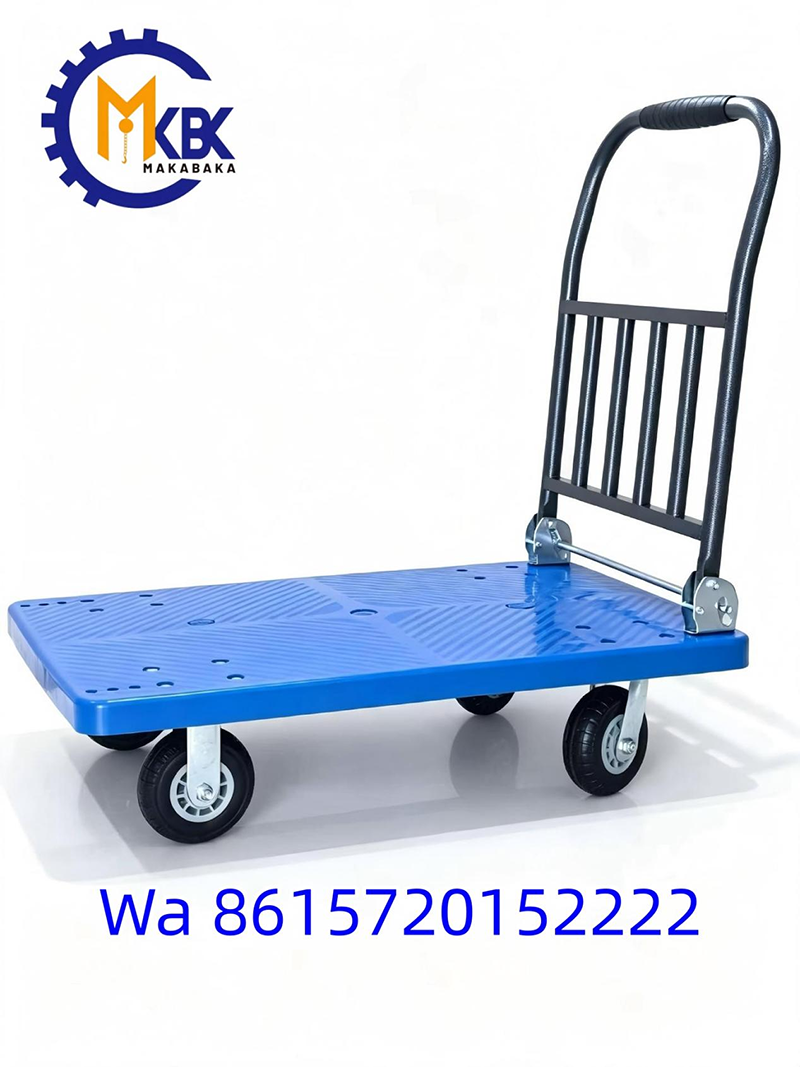
Instead of using one large platform and piling everything together, the two-level structure creates separate loading spaces. Combined with a welded handle, six supporting tubes and 6-inch industrial wheels, the result is a practical handcart designed for everyday industrial material handling.
At MKBK Hoist, we manufacture this type of industrial handcart in batches and can also customize the structure, dimensions and configuration according to customer requirements.
What Is a Double Layered Handcart?
A Double Layered Handcart is a manual material handling cart with two loading levels.
The basic idea is simple:
Use vertical space instead of only increasing the floor area.
The lower deck can carry heavier or larger items, while the upper deck can be used for boxes, tools, smaller components or frequently accessed materials.
This makes the cart particularly useful in environments where workers need to move several types of products at the same time.
Typical applications include:
· Warehouses
· Factories
· Workshops
· Logistics centers
· Retail backrooms
· Maintenance departments
· Assembly lines
· Distribution facilities
· Packaging areas
A similar principle is already widely used in industrial shelf trucks and double-deck material handling carts, where multiple levels help combine transportation and temporary storage.
But the real value isn't simply having two platforms.
The structure needs to remain stable when loaded and easy to control when pushed.
That is where engineering starts to matter.
Why Use Two Layers?
Imagine a worker needs to move:
· Small cartons
· Spare parts
· Hand tools
· Packaging materials
· Machine components
With a traditional single-deck cart, these items may end up stacked together.
The result?
The worker may need to stop and reorganize the load before reaching the destination.
A double-layer handcart provides another option.
Different materials can be separated between the upper and lower decks.
The goal isn't simply to carry more weight.
It is to make the load easier to organize.
This is especially useful in production environments where different components need to be delivered to the same workstation.
The Welded Handle: A Small Detail That Matters
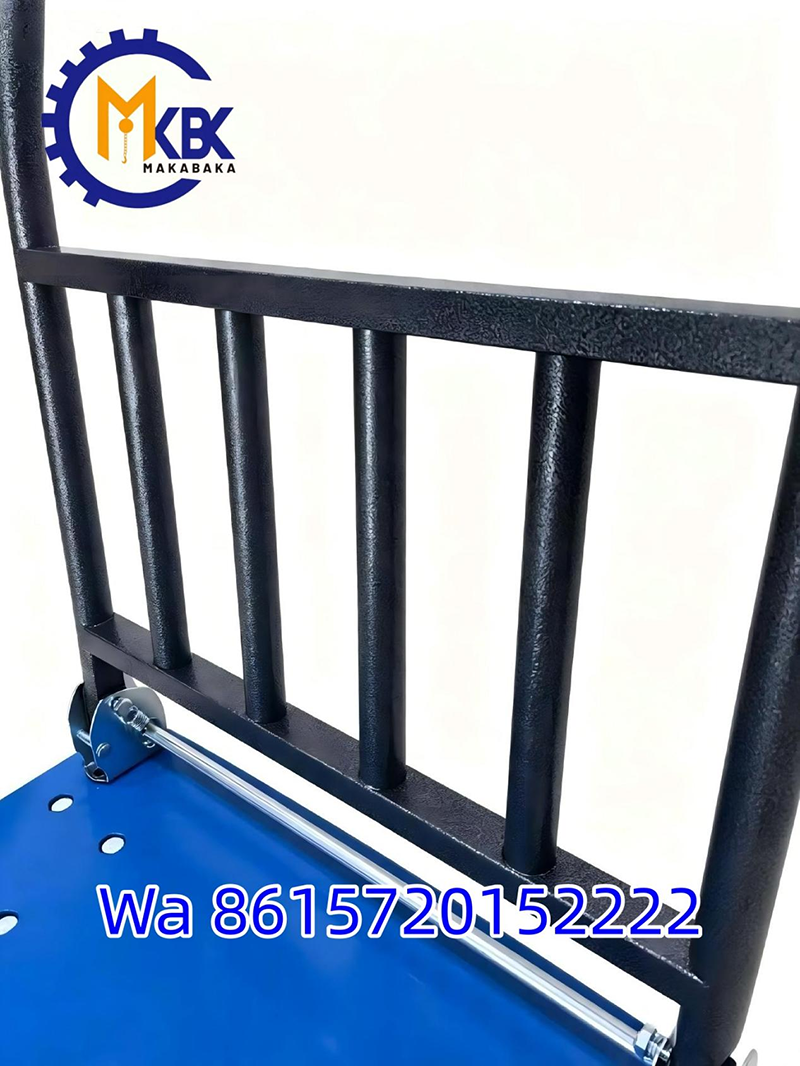
One of the most important features of this MKBK Hoist handcart is the welded handle.
Why weld the handle instead of using a simple detachable structure?
Because the handle is one of the areas that experiences repeated pushing and pulling forces.
Every time the operator accelerates, stops, changes direction or pushes the cart over a small floor irregularity, the handle transfers force into the frame.
A properly designed welded connection creates a rigid relationship between the handle and the main structure.
Industrial hand trucks and carts commonly use welded steel frames because the construction is intended for repeated professional use rather than occasional household transportation.
From an engineer's perspective, the question isn't simply:
“Can the handle hold the load?”
The better question is:
“How will the entire frame behave after thousands of pushing and pulling cycles?”
That's the difference between a cart designed for appearance and one designed for daily work.
Why Six Tubes?
Another noticeable feature is the six-tube support structure.
At first glance, six tubes may simply look like reinforcement.
But structurally, they serve a more important purpose.
A two-level cart needs to support the upper deck while transferring the load toward the main frame and wheels.
If the support structure is too weak, the upper deck can flex under load.
If the frame is not properly connected, repeated loading and movement can create unnecessary stress at the joints.
The six-tube design provides multiple structural support points between the decks and frame.
This helps distribute the load more evenly instead of concentrating everything at only a few locations.
Of course, the actual load capacity still depends on the complete design, including tube dimensions, material thickness, deck construction, welding quality, wheel configuration and load distribution.
More tubes do not automatically mean more capacity.
Good engineering means making the entire structure work together.
The 6-Inch Industrial Wheels
Now let's talk about the part that actually touches the floor.
The 6-inch industrial wheels may look like a basic component, but wheel selection can dramatically affect the user's experience.
A cart is only useful if it moves comfortably under its intended load.
Wheel diameter affects how the cart handles small floor gaps, thresholds and uneven surfaces.
In general, larger wheels can make it easier to roll over minor floor irregularities, although the final performance also depends on wheel material, bearing design, floor condition and load.
6-inch industrial wheels are widely used on heavy-duty material handling carts and platform trucks. Commercial industrial carts, for example, commonly pair 6-inch polyurethane wheels with welded steel construction for demanding material movement.
For our engineers, wheel selection is therefore not an afterthought.
We consider:
· Wheel diameter
· Wheel material
· Wheel load rating
· Bearing configuration
· Floor condition
· Cart weight
· Expected payload
· Frequency of movement
A cart used on a smooth factory floor has different requirements from one used in a workshop with expansion joints, loading areas or rougher surfaces.
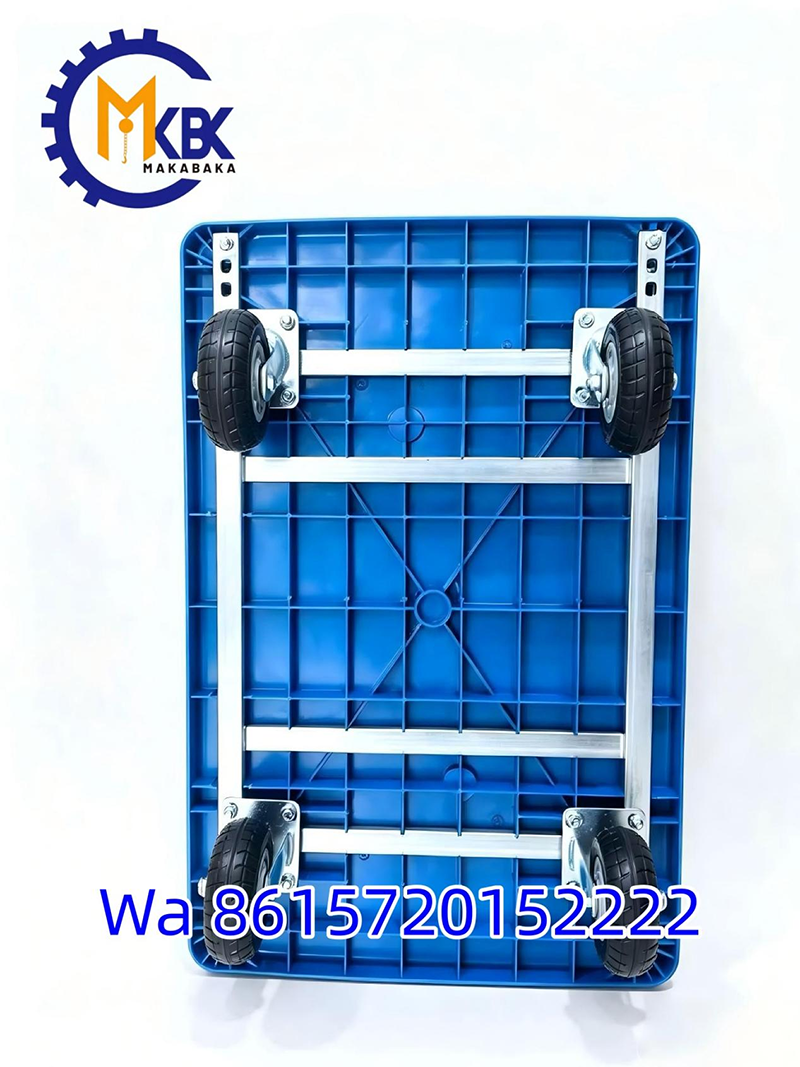
Why Wheel Position Matters
There is another detail that is easy to overlook.
It isn't enough to select a good wheel.
The wheel position also matters.
The relationship between the wheels, frame and center of gravity affects how the cart behaves when turning or stopping.
If the load is concentrated too far toward one side, the operator may feel the cart pulling in an unwanted direction.
If heavy material is placed too high, the center of gravity rises.
That can affect handling.
This is why we recommend thinking about how the cart will actually be loaded, not simply looking at the maximum theoretical capacity.
For daily industrial use, stable handling is just as important as carrying capacity.
Double Layer Does Not Mean “Load Everything”
This is something worth explaining.
A double-layer cart gives you two loading surfaces.
It does not mean that the maximum rated load can automatically be placed entirely on the upper deck.
The actual loading arrangement should follow the manufacturer's specifications.
Heavy materials should normally be positioned in a way that maintains a reasonable center of gravity and stable operation.
For example:
Lower deck:
Heavy boxes, machine components, tools or dense materials.
Upper deck:
Lighter cartons, small parts, packaging supplies or frequently accessed items.
This arrangement can make the cart easier to control and reduce unnecessary movement of the load.
The smartest loading method isn't always “put the heaviest thing wherever there is space.”
It is:
Put the right thing in the right place.
Where Can This Double Layered Handcart Be Used?
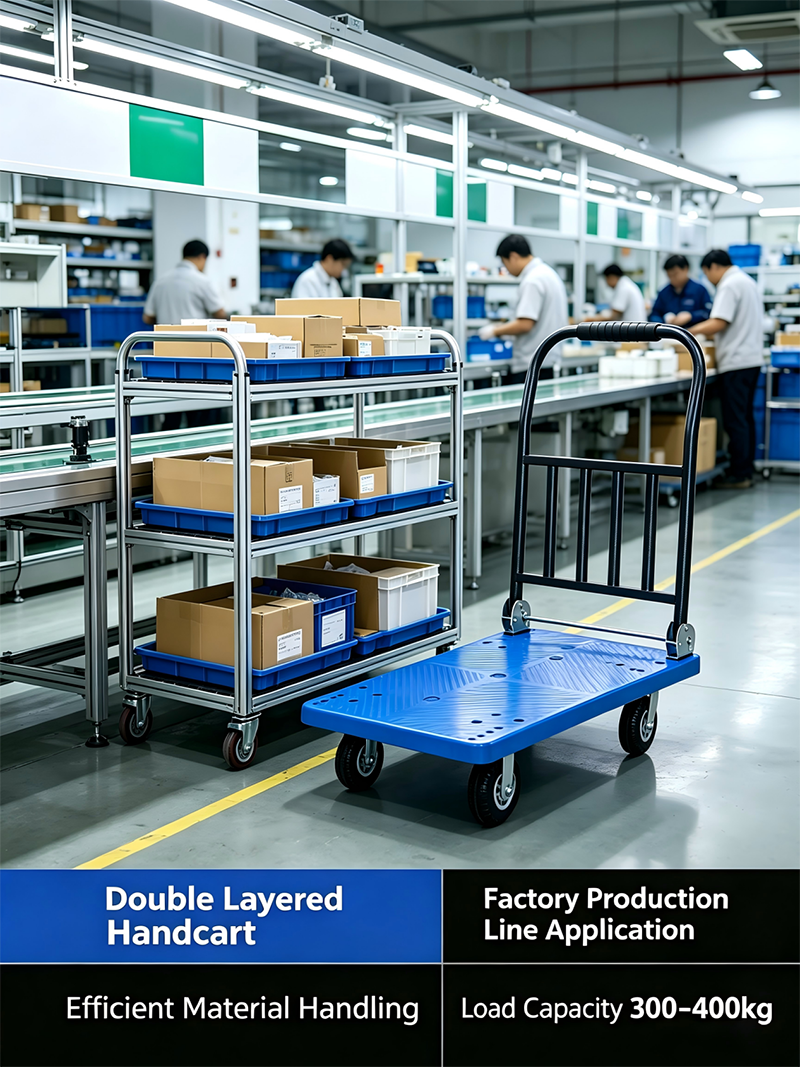
1. Factory Production Lines
Production lines often require components to move from storage to assembly areas.
A double-deck handcart can separate different types of components during transportation.
For example, the lower deck can carry larger boxes while the upper deck carries smaller parts.
2. Warehouses
In warehouses, workers often collect several items during one trip.
Instead of pushing an empty cart back and forth repeatedly, the two-level structure provides more usable loading space.
This can help improve the efficiency of internal material movement.
3. Maintenance Workshops
Maintenance technicians rarely carry only one thing.
They may need:
· Tools
· Replacement parts
· Lubricants
· Fasteners
· Electrical components
· Safety equipment
A two-level cart gives the technician a mobile workstation.
4. Packaging Areas
Packaging departments often need cartons, packaging materials and finished products moving continuously.
The cart can be used for short-distance transportation between packing stations and storage areas.
A Handcart Is Not Just a Cart
This is where our engineering team looks at the product differently.
A handcart is a small piece of equipment.
But it interacts directly with people every day.
That means usability matters.
A good industrial handcart should answer several questions:
Is the handle comfortable to push?
Does the frame feel rigid?
Does it roll smoothly?
Is the load easy to organize?
Can the operator turn it without excessive effort?
Can the structure survive repeated daily use?
These questions are much more useful than simply asking:
“What's the cheapest price?”
What Happens When the Cart Is Customized?
Not every customer needs exactly the same handcart.
Some customers need a longer platform.
Some need a wider cart.
Some need different deck heights.
Others may require a particular wheel material or a specific handle height.
For distributors, branding and local market requirements may also matter.
That's why MKBK Hoist supports customization.
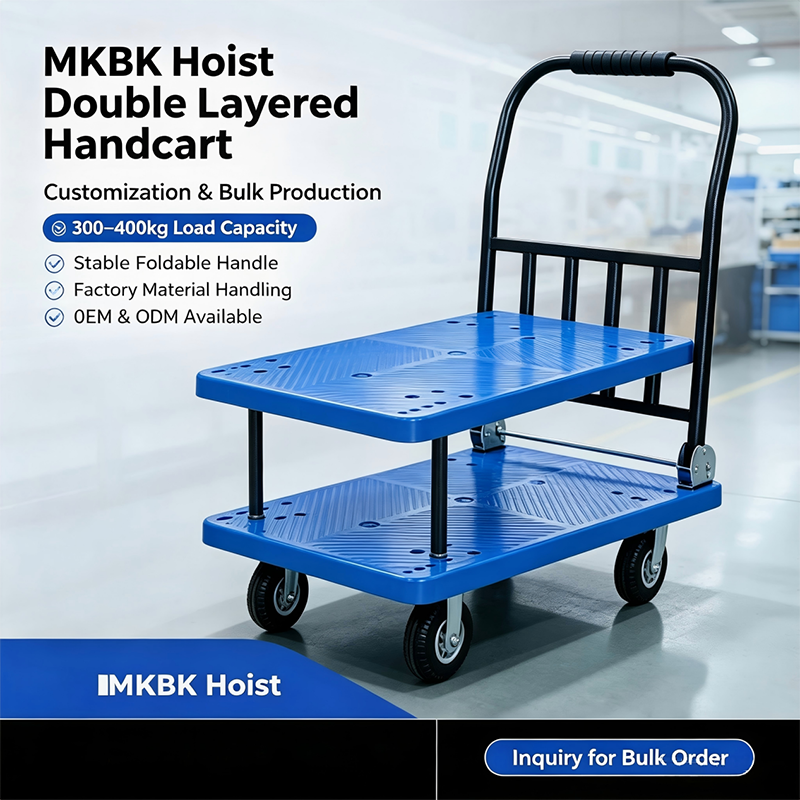
Depending on the project, customization can include:
· Overall dimensions
· Deck size
· Deck height
· Handle height
· Tube arrangement
· Tube diameter
· Number of support tubes
· Wheel configuration
· Wheel material
· Surface treatment
· Color
· Customer logo
· Packaging
· Loading requirements
The important point is that customization should not be treated as simply “changing the size.”
Changing the deck length can affect the frame.
Changing the deck height can affect the center of gravity.
Changing the wheel configuration can affect maneuverability.
Changing the load requirement can affect tube selection and welding design.
That's why our engineers review the complete structure before production.
How Our Engineers Look at the Frame
When developing or customizing an industrial handcart, we pay attention to several areas.
Frame Strength
The main frame needs to transfer the load toward the wheel assembly without unnecessary deformation.
Welded Joints
The welded joints need to be consistent and properly matched to the structure.
Deck Support
The two decks need adequate support for their intended loading conditions.
Handle Connection
The handle needs to remain rigid during repeated pushing and pulling.
Wheel Mounting
The wheel mounting points need to match the expected load and operating environment.
Center of Gravity
The loaded cart should remain controllable under normal operating conditions.
This is why a professional material handling product cannot be judged only from a product photograph.
Two carts may look almost identical.
Inside the manufacturing process, however, there can be a significant difference.
Why Batch Production Matters
For an individual user, buying one handcart is straightforward.
For an importer or distributor, the situation is different.
You may need:
100 units.
500 units.
1,000 units.
At that point, consistency becomes extremely important.
A factory needs to maintain consistent:
· Dimensions
· Welding positions
· Wheel installation
· Surface treatment
· Packaging
· Product appearance
· Functional performance
MKBK Hoist has the production capability to manufacture Double Layered Handcarts in batches.
This allows us to support both regular orders and customized projects.
Our goal is simple:
The 500th cart should look and work like the first one.
How to Choose the Right Double Layered Handcart?
Before placing an order, we recommend confirming these points.
1. What will you transport?
Boxes?
Machine parts?
Tools?
Bulk materials?
The load type affects deck design.
2. What is the expected load?
Don't estimate only the average load.
Consider the maximum realistic working load.
3. What are the cart dimensions?
Measure the aisle width, doorway width and workstation space.
A cart that is too large may be difficult to maneuver.
4. What floor will it operate on?
Smooth concrete?
Warehouse floor?
Workshop floor?
Loading area?
Wheel selection should match the environment.
5. How frequently will it be used?
A cart used twice a week has different requirements from one used continuously throughout an eight-hour shift.
6. Do you need customization?
If you need a specific size, wheel, color, handle height or tube arrangement, tell the manufacturer before production.
This makes it much easier to develop the right configuration from the beginning.
Why MKBK Hoist?
At MKBK Hoist, we don't believe an industrial handcart needs to be complicated.
It needs to be practical.
Strong where it needs to be strong.
Easy to move.
Easy to load.
Easy to maintain.
And consistent enough to handle everyday work.
Our Double Layered Handcart combines a two-level loading structure with a welded handle, six supporting tubes and 6-inch industrial wheels.
We manufacture in volume and support customized production according to customer requirements.
Whether you are a distributor, importer, warehouse equipment supplier, factory or industrial user, we can discuss the application first and then work out the suitable configuration.
You don't have to start by asking:
“Which model should I buy?”
Start with:
“What do I need to move, and how will I move it?”
That's where good engineering begins.
And that's how a simple handcart becomes a useful part of your material handling system.
MKBK Hoist — Practical equipment. Solid manufacturing. Built around the job.

 Factory Address: Dongl ü industrial Area,Qingyuan District, Baoding City, Hebei Province, China
 Contact number:
 Emall:
  Website:





 Home
Home Whatsapp
 Email
Email