
 English
 русский
 Español
 Indonesia
 Tiếng Việt

 Current Location:
-
How to Choose an Electric Pallet Truck for Warehouse Operations
-
Electric Pallet Truck for Warehouse Material Handling: Improving Daily Warehouse Operations
-
Buy Guide: MKBK Hoist Crane Manual Permanent Magnet Lifter Magnetic for Metal Fabrication
-
MKBK Hoist Crane Manual Permanent Magnet Lifter Magnetic: Power‑Free Heavy‑Duty Metal Lifting

Online consulting
If you have any questions, please contact our online customer service staff immediately
How to Choose an Electric Pallet Truck for Warehouse Operations
 Click:19
 Time:2026-11-14 15:30:17
Selecting the right Electric Pallet Truck is an important decision for warehouses, distribution centers and manufacturing facilities. The right equipment should match the loads being transported, pallet dimensions, warehouse layout and daily operating schedule.
While purchase price is an important consideration, businesses should also evaluate battery technology, maintenance requirements, charging arrangements and long-term operating costs. This guide explains the key factors to consider before purchasing an electric pallet truck.

1. Understand Your Warehouse Transportation Requirements
Before comparing different electric pallet truck models, identify the actual transportation tasks performed in your facility. A warehouse handling a limited number of pallets each day may have different requirements from a busy distribution center with continuous inbound and outbound material movement.
Consider the following operational questions:
- What is the maximum weight of a fully loaded pallet?
- How many pallets are moved during a typical shift?
- What is the average transportation distance?
- How wide are the warehouse aisles?
- Are operations performed in one shift or multiple shifts?
- Is the equipment mainly used indoors or in designated loading areas?
These details help determine the appropriate equipment capacity, fork configuration, battery arrangement and operational requirements.
2. Choose the Correct Load Capacity
Load capacity is one of the most important specifications when selecting an electric pallet truck. The rated capacity indicates the maximum load the equipment is designed to handle under its specified operating conditions.
Businesses should calculate the actual gross pallet load rather than relying on the average weight of transported goods. The pallet itself should also be included when assessing the total load.
| Selection Factor | What to Check | Why It Matters |
|---|---|---|
| Maximum Load | Heaviest fully loaded pallet | Ensures capacity suitability |
| Average Load | Typical daily pallet weight | Helps evaluate operating demand |
| Load Distribution | Position and balance of cargo | Supports stable handling |
| Working Conditions | Floor and operating environment | Determines equipment suitability |
For example, the MK Hoist EV300 product page lists a rated capacity of 3T. This makes it a model worth evaluating for operations that require a higher-capacity pallet transportation solution, subject to confirmation of the final rated specification and operating conditions.
3. Check Fork Dimensions and Pallet Compatibility
An electric pallet truck must be compatible with the pallets used in the warehouse. Fork length, overall fork width, fork spacing and pallet entry dimensions should all be checked before ordering.
Different facilities may use standard wooden pallets, plastic pallets or specialized industrial pallets. Their dimensions and bottom structures can vary significantly.
The MK Hoist EV300 product information lists a fork length of 1160 and overall fork width options of 550mm and 685mm. The fork length unit should be confirmed with the supplier before final selection.
Buyers should provide their pallet drawings or actual pallet measurements when requesting a quotation. This helps the supplier verify whether the proposed fork configuration is suitable.
4. Compare Lead-Acid and Lithium Battery Options
Battery technology influences the initial equipment investment, charging arrangements, maintenance procedures and operating schedule. Lead-acid and lithium-ion batteries are two common technologies used in powered material handling equipment.
| Comparison Factor | Lead-Acid Battery | Lithium-Ion Battery |
|---|---|---|
| Initial Investment | Generally lower | Generally higher |
| Maintenance | Requires battery-specific maintenance, including water-level checks for applicable flooded batteries | Generally requires less routine battery maintenance |
| Charging Management | Requires appropriate full charging procedures | Often supports more flexible charging strategies, depending on the battery system |
| Operating Planning | Charging time and battery availability must be planned | Charging opportunities and battery configuration should be evaluated |
| Best Selection Approach | Suitable when established charging and maintenance routines are available | Worth evaluating when reduced maintenance and charging flexibility are priorities |
There is no universally best battery technology for every warehouse. The appropriate choice depends on working hours, available charging facilities, maintenance capability and the total cost of ownership.
The MK Hoist EV300 is listed with a lead-acid battery. This configuration is worth considering for businesses that prioritize established battery technology and a lower initial purchase investment.
5. Evaluate Charging and Battery Maintenance
Battery management should be included in warehouse operating plans. A lead-acid battery requires suitable charging conditions and regular inspections to maintain reliable performance.
Recommended management practices include:
- Follow the battery manufacturer's charging instructions.
- Check battery water levels where applicable and use distilled water.
- Keep battery terminals clean and properly secured.
- Avoid incomplete charging routines that may contribute to sulfation.
- Provide suitable ventilation in designated charging areas.
- Keep sparks and open flames away from battery charging areas.
- Train operators and maintenance personnel in battery safety procedures.
For multi-shift operations, businesses should evaluate charging windows, spare battery availability and equipment utilization before purchasing. The actual charging duration must be confirmed using the battery and charger specifications.
6. Consider Warehouse Layout and Working Conditions
Equipment capacity alone does not determine whether a pallet truck is suitable for a warehouse. The operating environment also plays an important role.
Aisle Width and Turning Space
Measure the available aisle width and turning clearance. The selected equipment must have sufficient maneuvering space for the actual pallet dimensions and load configuration.
Floor Conditions
Smooth, level floors generally provide more suitable conditions for pallet transportation. Damaged flooring, uneven transitions and slopes should be assessed before equipment selection.
Loading Dock Requirements
If the equipment is used around loading docks, verify dock level, vehicle access, ramp conditions and available maneuvering space. Not every electric pallet truck is suitable for every ramp or dock.
7. Calculate the Total Cost of Ownership
Purchasing decisions should consider more than the initial equipment price. The total cost of ownership includes several factors that affect the equipment's financial value over its operating life.
| Cost Category | Items to Evaluate |
|---|---|
| Purchase Cost | Equipment price, optional configurations and delivery |
| Energy Cost | Electricity consumption and charging arrangements |
| Maintenance Cost | Battery care, inspections and replacement parts |
| Operating Cost | Labor allocation and equipment utilization |
| Downtime Cost | Maintenance interruptions and spare equipment planning |
A lower initial purchase price does not automatically mean a lower lifetime cost. Buyers should compare equipment options using their actual operating hours, maintenance resources and expected service requirements.
8. Why Consider the MK Hoist EV300 Electric Pallet Truck?
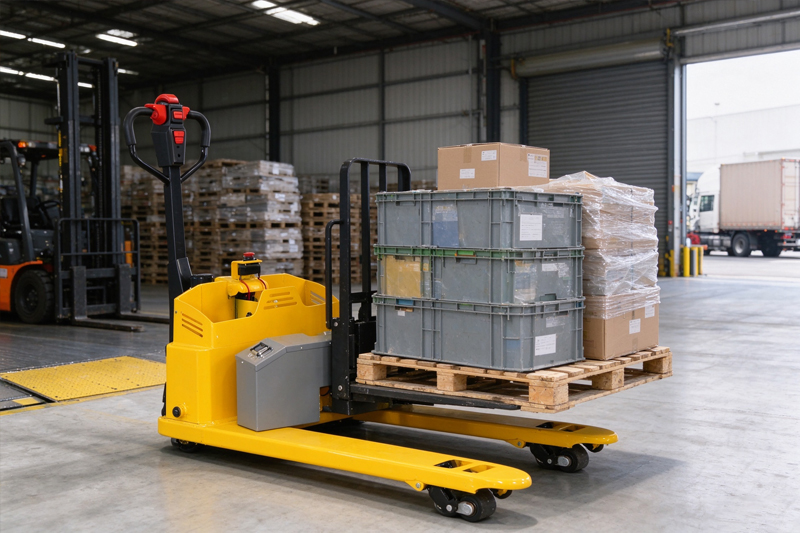
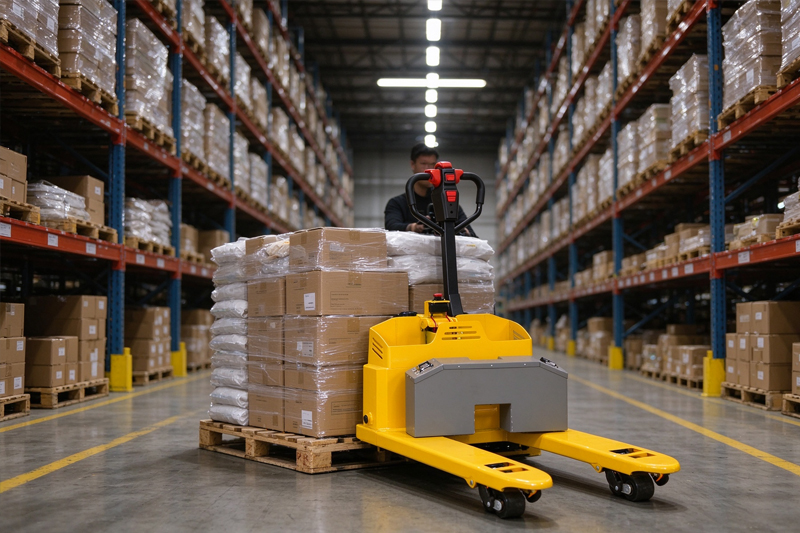
The MK Hoist EV300 is a lead-acid battery-powered electric pallet truck designed for pallet transportation in warehouses, distribution centers, loading docks and production environments.
Its listed specifications provide a starting point for businesses evaluating higher-capacity pallet handling equipment.
- 3T rated capacity listed on the product page.
- Lead-acid battery technology.
- 550mm and 685mm overall fork width options listed.
- Suitable application categories include warehouse and logistics handling.
- Established battery maintenance and charging procedures.
Before ordering, confirm the product model designation, rated capacity, fork length unit, battery capacity and configuration with MK Hoist.
Frequently Asked Questions About Electric Pallet Trucks
What is an Electric Pallet Truck used for?
An Electric Pallet Truck is used to lift and transport palletized goods horizontally. Common applications include warehouses, distribution centers, manufacturing facilities and loading docks.
How do I choose the right electric pallet truck capacity?
Determine the maximum gross weight of your pallet loads and select equipment with a suitable rated capacity. Also consider load distribution, pallet dimensions and actual working conditions.
What is the difference between an electric pallet truck and a forklift?
An electric pallet truck is primarily designed for horizontal pallet transportation with limited lifting height. A forklift is designed for a broader range of lifting and stacking operations, including handling loads at greater heights.
Is a lead-acid battery suitable for warehouse operations?
Yes. Lead-acid batteries can be suitable for warehouses with established charging routines, appropriate maintenance resources and compatible operating schedules. Their suitability depends on actual usage patterns.
What maintenance does a lead-acid electric pallet truck require?
Maintenance depends on battery construction and manufacturer instructions. Applicable flooded lead-acid batteries require water-level checks, terminal inspections and proper charging procedures. Other equipment components should also be inspected according to the maintenance schedule.
Can an electric pallet truck be used for loading and unloading trucks?
It can support suitable loading and unloading operations when the vehicle, dock, ramp, floor and equipment configuration are compatible. Always verify the operating conditions before use.
Why should buyers check fork dimensions before purchasing?
Fork length, width and spacing must be compatible with the pallets being handled. Correct dimensions help provide appropriate load support and stable transportation.
Final Thoughts: Select Equipment Based on Real Operating Needs
Choosing the right Electric Pallet Truck requires a complete understanding of warehouse loads, pallet dimensions, operating distances, battery management and maintenance requirements.
The MK Hoist EV300 offers a lead-acid battery-powered option for businesses evaluating pallet transportation equipment for warehouse and logistics applications.
Contact MK Hoist with your pallet dimensions, maximum load weight and daily operating requirements to discuss a suitable material handling solution.
- Previous Article:
- Next Article: Electric Pallet Truck for Warehouse Material Handling: Improving Daily Warehouse Operations

 Factory Address: Dongl ü industrial Area,Qingyuan District, Baoding City, Hebei Province, China
 Contact number:
 Emall:
 Website:





 Home
 Whatsapp
 Email